Tuesday, 28. November 2006
voices
last May one Brandeis student who is herself Izraeli Jewish for her class of peace building through art decided to put up an exhibition by Palestinian children or teenagers from a refugee camp just near the wall of separation. it was named "Voices of Palestine".

however, the paintings hung in the library met a controversial end. the president of the university where half of the students are Jewish, most likely due to pressure from donors, ordered the paintings to be removed after only several days they had been on display in the far corner down the third floor. the official reason was that they were too insulting and shocking for Brandeis community... with a snake forming David's star, the wall and Arab blood spilt by Izraeli tanks. this was the reality the children saw around them, growing up in the camp. to some peoples' opinion, this was politics in the disguise of art. yet most welcomed the exhibition because the voices of the Palestinians are rarely heard here. yes, Brandeis has partnership with al-Quds university, which is an Arab institution. and Tony Kushner who wrote the screenplay for Steven Spielberg's "Munich", recieved an honorary doctorate degree at Brandeis the same May. besides, Heller school and coexistance program are one of the best programs in peace building in the country... and still, the exhibition was down, "the Boston globe" wrote about this scandal of academic free speech denial to Izraeli's political enemies and censorship at a so-called "secular" Jewish institution which was accused by some as being zionist... and the paintings went to M.I.T. leaving Brandeis is shock and disagreement, distrust and frustration among its community members which continue into today.

at "Museums and Public memory" class this morning we were discussing this controversial exhibition behind shut doors and with promisses not to uncover the details of disputes and fractures in the university's administration. then Nadia, who is originally Lebanese, but is American citizen, spoke up... about how unsafe she feels in her country... that after the war in Lebanon had started she didn't want to leave home for a week... that at Brandeis Arab students receive death threats and nobody cares about that... Nadia cried when she was talking... the class was speechless. this opened my eyes... not that i had never noticed and realized, but i had never thought that it does have a direct impact on my fellow students... Izraeli politics and class asignements at Brandeis are so closely connected... as are lives and comfort of Arab students with the funding university gets from wealthy Jews... this matrix of power is threatening... and there is nothing one can do... not even faculty members who can object only to the limit of being fired for one-sidedness, for expressing only one view... our Southern Sudanese refugees' exhibition will take the place of the "Voices of Palestine". however many discussions and ethical questions it might raise, since it has nothing to to with Izrael, freedom of speech is in our hands. it is much easier to criticize the government of the United States that the one in Izrael. at least that is what i have learnt so far. through the tears of my friend.
however, the paintings hung in the library met a controversial end. the president of the university where half of the students are Jewish, most likely due to pressure from donors, ordered the paintings to be removed after only several days they had been on display in the far corner down the third floor. the official reason was that they were too insulting and shocking for Brandeis community... with a snake forming David's star, the wall and Arab blood spilt by Izraeli tanks. this was the reality the children saw around them, growing up in the camp. to some peoples' opinion, this was politics in the disguise of art. yet most welcomed the exhibition because the voices of the Palestinians are rarely heard here. yes, Brandeis has partnership with al-Quds university, which is an Arab institution. and Tony Kushner who wrote the screenplay for Steven Spielberg's "Munich", recieved an honorary doctorate degree at Brandeis the same May. besides, Heller school and coexistance program are one of the best programs in peace building in the country... and still, the exhibition was down, "the Boston globe" wrote about this scandal of academic free speech denial to Izraeli's political enemies and censorship at a so-called "secular" Jewish institution which was accused by some as being zionist... and the paintings went to M.I.T. leaving Brandeis is shock and disagreement, distrust and frustration among its community members which continue into today.
at "Museums and Public memory" class this morning we were discussing this controversial exhibition behind shut doors and with promisses not to uncover the details of disputes and fractures in the university's administration. then Nadia, who is originally Lebanese, but is American citizen, spoke up... about how unsafe she feels in her country... that after the war in Lebanon had started she didn't want to leave home for a week... that at Brandeis Arab students receive death threats and nobody cares about that... Nadia cried when she was talking... the class was speechless. this opened my eyes... not that i had never noticed and realized, but i had never thought that it does have a direct impact on my fellow students... Izraeli politics and class asignements at Brandeis are so closely connected... as are lives and comfort of Arab students with the funding university gets from wealthy Jews... this matrix of power is threatening... and there is nothing one can do... not even faculty members who can object only to the limit of being fired for one-sidedness, for expressing only one view... our Southern Sudanese refugees' exhibition will take the place of the "Voices of Palestine". however many discussions and ethical questions it might raise, since it has nothing to to with Izrael, freedom of speech is in our hands. it is much easier to criticize the government of the United States that the one in Izrael. at least that is what i have learnt so far. through the tears of my friend.
jusionyte, 17:30h
... link (0 Kommentare) ... comment
Saturday, 28. October 2006
waan ku yom ku dom ku baai
Being part of this exhibition project has been an amazing experience.
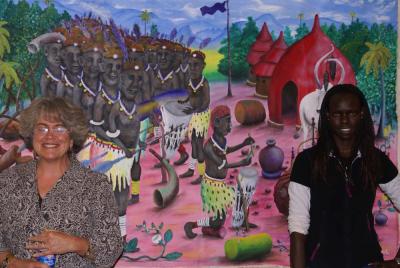
Firstly, the paintings themselves are beautiful, some really sad, some nostalgic, some showing the present day reality in Kakuma refugee camp and the lands of Dinka, Nuer and other people from Southern Sudan and the hopes of these people, but all colorful and reaching the depths of those who spend some time looking at them. Then, the entire process of arranging the paintings on the walls at Dreizer and discussions at class and after class that took hours were heated but worth engaging in. To stretch the canvases or leave them as they are? To write captions in an authoritative voice or let the artist and the community members speak about their impressions? Or maybe no captions are necessary and we could put all the information in a brochure? And what about the audio or video tour? Despite there being diverse opinions, we, as a class, succeeded in finding the solution which surprised me at the opening ceremony. It was a great event.
As an anthropologist I am eager to study immigrant communities in the U.S. and the plurality of memories in the public space, and being involved in this project I had a chance to listen to stories of the refugees, survivors of the genocide which the world did not notice at the time. Although I did spent some afternoons creating texts for the captions and then printing and sticking them to the foam board, which is an unavoidable job one has to engage in when making an exhibition, it was really the possibility to meet the members of the Southern Sudanese diaspora community that was the most rewarding for me as a person, as an academic and as a journalist. Talking to Atem Aleu over the phone about the danger of going back to his memories and the empty village, listening to Panther Alier sharing his memories of daily life and survival in the refugee camps, walking through the paintings in the gallery with another Atem, taking pictures of the performances of Southern Sudanese and the auction in Lincoln where the naming rights and the reproductions of the paintings were sold to good-willing citizens of the U.S. – these were the moments that I treasure the most. I believe that without the cooperation with the refugee community and the Sudanese Education Fund, especially Susan Winship, we could not have gone so far. And, undoubtedly, the class benefited a lot from having Aduei among us all the time – her opinion was crucially important and she explained many things of which we had not been aware.
What would be the important moments that I remember?
Certainly, we were struggling between creating an exhibition based on resonance and that of wonder, as S. Greenblatt would say. On the one hand, we wanted to tell the story, to make people aware of what was and is happening in Southern Sudan, to explain what symbols and what narratives are depicted in the paintings; that is, as students of anthropology, cultural production or other social sciences we wanted to educate. Aduei was particularly firm on this position. But on the other hand, exhibiting paintings is not the same as putting some household items on display. Although these are the objects of legacy telling the story of Southern Sudan, they are also works of art, they are the visions by individual painters, most still in the camp and not all of them Dinka. I recall that understanding the paintings of Stephenal was difficult even for the Southern Sudanese and they came up with different interpretations when viewing them. Usually, art galleries do not attach captions to their paintings, telling what and why is being depicted in each of them. What change would it make if under E. Munch’s “The Cry” one could read “the author makes reference to the fate of an individual in our society, etc.”? We were trapped and I did not really know how to balance the need of resonance and the wish to leave some space to wonder until the idea of using the quotes from the interviews that we had recorded came up. Let the artist speak for himself, let other community members, who have similar backgrounds, talk about them, and let the class also add its comments where appropriate. The decision to use multiple voices was a perfect solution to the problem and I have heard many compliments to the class for doing this.
The exhibition is our collective project and probably it is this dynamism and fusion of ideas that come from our different backgrounds that make it so dear to me. I am more than certain that we should not break it up, that we should not take the paintings to some dark room at Brandeis for years of loneliness in the dust. We should make it travel and make sure that as many people as possible see it. It might be our small contribution to assisting the people of Southern Sudan. The days of Victorian anthropologists who would work side by side with the government and the colonial powers to subject local peoples are long gone. The anthropologists have moved underground, they have joined their communities to work hand in hand in their struggle against the social and political injustice. This is what is meant by engaged anthropology and that is the kind of social science that I find meaningful.
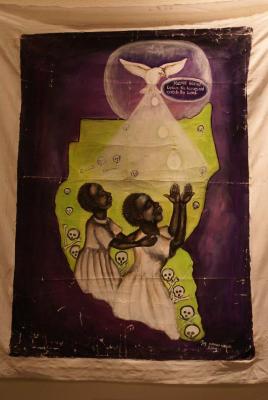
Visit our class wiki, until we create the official website:
http://museumsmemory.wikispaces.com/South+Sudan+Community+Project
Firstly, the paintings themselves are beautiful, some really sad, some nostalgic, some showing the present day reality in Kakuma refugee camp and the lands of Dinka, Nuer and other people from Southern Sudan and the hopes of these people, but all colorful and reaching the depths of those who spend some time looking at them. Then, the entire process of arranging the paintings on the walls at Dreizer and discussions at class and after class that took hours were heated but worth engaging in. To stretch the canvases or leave them as they are? To write captions in an authoritative voice or let the artist and the community members speak about their impressions? Or maybe no captions are necessary and we could put all the information in a brochure? And what about the audio or video tour? Despite there being diverse opinions, we, as a class, succeeded in finding the solution which surprised me at the opening ceremony. It was a great event.
As an anthropologist I am eager to study immigrant communities in the U.S. and the plurality of memories in the public space, and being involved in this project I had a chance to listen to stories of the refugees, survivors of the genocide which the world did not notice at the time. Although I did spent some afternoons creating texts for the captions and then printing and sticking them to the foam board, which is an unavoidable job one has to engage in when making an exhibition, it was really the possibility to meet the members of the Southern Sudanese diaspora community that was the most rewarding for me as a person, as an academic and as a journalist. Talking to Atem Aleu over the phone about the danger of going back to his memories and the empty village, listening to Panther Alier sharing his memories of daily life and survival in the refugee camps, walking through the paintings in the gallery with another Atem, taking pictures of the performances of Southern Sudanese and the auction in Lincoln where the naming rights and the reproductions of the paintings were sold to good-willing citizens of the U.S. – these were the moments that I treasure the most. I believe that without the cooperation with the refugee community and the Sudanese Education Fund, especially Susan Winship, we could not have gone so far. And, undoubtedly, the class benefited a lot from having Aduei among us all the time – her opinion was crucially important and she explained many things of which we had not been aware.
What would be the important moments that I remember?
Certainly, we were struggling between creating an exhibition based on resonance and that of wonder, as S. Greenblatt would say. On the one hand, we wanted to tell the story, to make people aware of what was and is happening in Southern Sudan, to explain what symbols and what narratives are depicted in the paintings; that is, as students of anthropology, cultural production or other social sciences we wanted to educate. Aduei was particularly firm on this position. But on the other hand, exhibiting paintings is not the same as putting some household items on display. Although these are the objects of legacy telling the story of Southern Sudan, they are also works of art, they are the visions by individual painters, most still in the camp and not all of them Dinka. I recall that understanding the paintings of Stephenal was difficult even for the Southern Sudanese and they came up with different interpretations when viewing them. Usually, art galleries do not attach captions to their paintings, telling what and why is being depicted in each of them. What change would it make if under E. Munch’s “The Cry” one could read “the author makes reference to the fate of an individual in our society, etc.”? We were trapped and I did not really know how to balance the need of resonance and the wish to leave some space to wonder until the idea of using the quotes from the interviews that we had recorded came up. Let the artist speak for himself, let other community members, who have similar backgrounds, talk about them, and let the class also add its comments where appropriate. The decision to use multiple voices was a perfect solution to the problem and I have heard many compliments to the class for doing this.
The exhibition is our collective project and probably it is this dynamism and fusion of ideas that come from our different backgrounds that make it so dear to me. I am more than certain that we should not break it up, that we should not take the paintings to some dark room at Brandeis for years of loneliness in the dust. We should make it travel and make sure that as many people as possible see it. It might be our small contribution to assisting the people of Southern Sudan. The days of Victorian anthropologists who would work side by side with the government and the colonial powers to subject local peoples are long gone. The anthropologists have moved underground, they have joined their communities to work hand in hand in their struggle against the social and political injustice. This is what is meant by engaged anthropology and that is the kind of social science that I find meaningful.
Visit our class wiki, until we create the official website:
http://museumsmemory.wikispaces.com/South+Sudan+Community+Project
jusionyte, 17:10h
... link (0 Kommentare) ... comment
Sunday, 15. October 2006
refugees in da house
for the "museums and public memory: cultural production" class we are working with the community of refugees from Southern Sudan in Boston. there are nearly four thousand of them in the States, where they arrived from the Kakuma refugee camp in Kenya before 9/11. and they reached Kakuma after several years of travelling through Sudan, after being in Ethiopia, after being reduced by half or more by the bombs, crocodiles, starvation, deseases... even if you listen to their stories, still can't believe it, how they made it... there is a wonderful book by three of these refugees, which are called 'lost boys of Sudan', although there were some girls among them. the book is entitled "they poured fire on us from the sky". the kids had to leave there home in Sudan at the age of three, four, five, six... their parents were killed or lost, villages burned... in the camps they painted as some guy brought them some canvas and brushes. now we have these paintings or, more correctly, the Southern Sudanese education fund has them, and we are preparing an exhibition. difficult, as we don't agree how much explanation should be given on each painting... or let the art speak for itself... we have been doing interviews with these refugees who are about our age and study in various universities, like Brandeis and University of Massachusetts... setting up an exhibition like this is difficult. and most of the artists are still in Kakuma camp. they need some money.
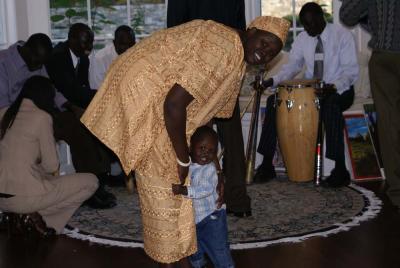
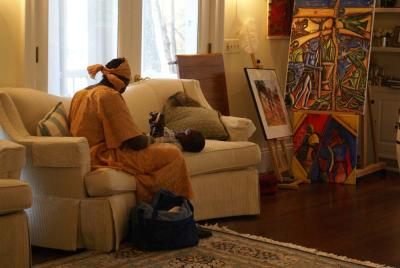
today in Lincoln, the fanciest suburb of Boston, there was a cocktail party for the rich and famous where the Sudanese refugees sang and danced and where the paintings were sold in an auction... well, only the right to have your name on the painting and the reproduction as the paintings will be stored at Brandeis after travelling around Boston for some exhibitions. more than a hundred people showed up, including the democrat candidate for the presidential election some years ago... i was asked by my professor to be the photographer of the event. weird but good event. those rich and famous spent hundreds and thousands of dollars for the reproductions, for the pictures, for the evening with some refugees, for the wine, for a four-day stay in a villa in South Africa... and just donated for the books of the refugees who are already in the U.S. they told stories about their flight from terror, wandering around Sudan for years and coming here... sad stories but with a happy ending, at least for some. Aduei, my classmate at Brandeis, was among them...
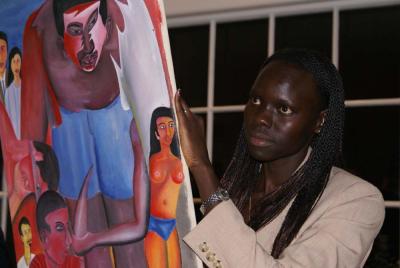
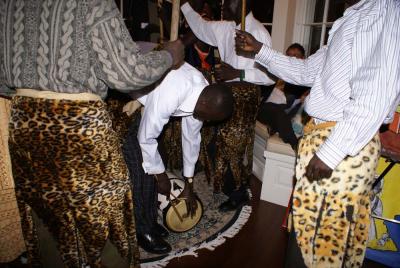
although it was sad and a bit disappointing to contrast this elite with the life of the refugees... it was also good. the party had a purpose, i think. if i had the money, i could donate them for this purpose.
look here for more pictures...
http://picasaweb.google.com/ieva.jusionyte/SouthernSudanese
today in Lincoln, the fanciest suburb of Boston, there was a cocktail party for the rich and famous where the Sudanese refugees sang and danced and where the paintings were sold in an auction... well, only the right to have your name on the painting and the reproduction as the paintings will be stored at Brandeis after travelling around Boston for some exhibitions. more than a hundred people showed up, including the democrat candidate for the presidential election some years ago... i was asked by my professor to be the photographer of the event. weird but good event. those rich and famous spent hundreds and thousands of dollars for the reproductions, for the pictures, for the evening with some refugees, for the wine, for a four-day stay in a villa in South Africa... and just donated for the books of the refugees who are already in the U.S. they told stories about their flight from terror, wandering around Sudan for years and coming here... sad stories but with a happy ending, at least for some. Aduei, my classmate at Brandeis, was among them...
although it was sad and a bit disappointing to contrast this elite with the life of the refugees... it was also good. the party had a purpose, i think. if i had the money, i could donate them for this purpose.
look here for more pictures...
http://picasaweb.google.com/ieva.jusionyte/SouthernSudanese
jusionyte, 01:01h
... link (0 Kommentare) ... comment
Friday, 13. October 2006
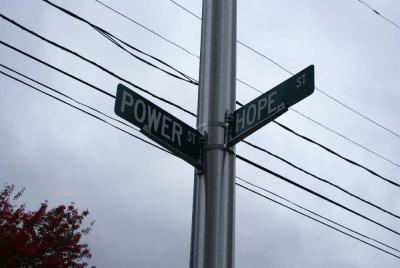
at the crossroads
jusionyte, 04:04h
... link (1 Kommentar) ... comment
Saturday, 30. September 2006
i read all day... i read all night
i wish there was an anonymous club for amazon.com addicts because i am one of them. i buy books with just one click. more and more books i have heard and never heard of. my small room is becoming full of them... on my table, on the floor, on my bed... books everywhere... at the bookstore near the harvard square there are so many of them... and dictionaries of all languages imaginable... different dialects of arabic, armenian, cambodian, african tongues... i love being there. and i love the smell of old books. and almost everyday i find a parcel outside our door... one more book has arrived:) yesterday simon and uli even had to carry me while we were passing the harvard bookstore as i am mad about books. i need a club for someone like me... "hello. my name is ieva. i come from europe. i buy books. everyday. i think i am obsessed. will you help me?"

for those curious about what i am reading, here is the list of the compulsory literature for this semester. books and articles, all mixed up. but appart from that there are other books which i have always wanted to have... renato rosaldo, more antonio gramsci, pierre bourdieu, sudan and chile. should i open a bookstore?
Herodotus, Egypt
Tacitus, On Germany
Bartholome de las Casas, In defence of the indians
Montainge, On Cannibals
Thomas Hobbes, Leviathan
John Locke, The Two Treatises of Government
Giambattista Vico, The New Science
Jean-Jacques Rousseau, A Discourse on Inequality
James Cowles Pritchard, Researches into the Physical History of Man
Auguste Comte, System of Positive Philosophy
Henry Maine, Ancient Law
E. B. Tylor, Primitive Culture
Karl Marx, The Economic and Philosophic Manuscripts of 1844
Karl Marx and Frederick Engels, The German Ideology
Karl Marx, "Forms Which Precede Capitalist Production," Grundrisse
Lewis Henry Morgan, Ancient Society
Karl Marx, Capital I
Max Weber, The Protestant Ethic and the Spirit of Capitalism.
Max Weber. “Objectivity in Social Science and Social Policy.”
Georg Simmel. On the Nature of Historical Understanding
Georg Simmel. The Metropolis and Mental Life
Georg Simmel. The Stranger
Freud, “Fixation to Traumas-The Unconscious”
Freud, “Obsessive Acts and Religious Practices”
Freud, “Reflections upon War and Death”
Freud “One of the Difficulties of Psychoanalysis”
Freud, Civilization and its Discontents
Fustel de Coulanges. The Ancient City
Emile Durkheim, "Individual and Collective Representation"
Emile Durkheim, “The Dualism of Human Nature and Its Social Condition
Emile Durkheim, The Elementary Forms of the Religious Life
Emile Durkheim, “The Realm of Sociology as a Science”
Emile Durkheim and Marcel Mauss, Primitive Classification
Marcel Mauss, The Gift,
Robert Hertz. “Death and the Left Hand”
James G. Frazer, “On Certain Burial Customs as Illustrative of the Primitive Theory of the Soul”
A.C. Haddon, “Migration of Cultures in British New Guinea”
W. H. R. Rivers, “On the Origin of the Classificatory System of Relationships”
W. H. R. Rivers, “The Unity of Anthropology”
A.R. Radcliffe Brown, "The Mother's Brother in South Africa"
A.R. Radcliffe Brown, "On Social Structure
A.R. Radcliffe-Brown, “The Comparative Method in Social Anthropology”
A.R. Radcliffe-Brown, “On the Concept of Function in Social Science”
Bronislaw Malinowski, "The Group and the Individual in Functional Analysis”
Bronislaw Malinowski, “Baloma”
Bronislaw Malinowski, Coral Gardens and Their Magic
Bronislaw Malinowski, Argonauts of the Western Pacific
Bronislaw Malinowski. Sex and Repression in Savage Society
Ernst Jones, "Mother-Right and Sexual Ignorance of Savages," Essays in Applied Psychoanalysis
Parsons, A., Is the Oedipus complex universal? The Jones-Malinowski debate revisited
Evans Pritchard. The Nuer
Evans-Pritchard. Nuer Religion
T.O. Beidelman. “Nuer priest and prophets”
Douglas Johnson. Nuer prophets
Franz Boas, "The Aims of Ethnology"
Franz Boas, "Human Faculty as Determined by Race"
Franz Boas, "The Limitations of the Comparative Method"
Franz Boas, “Growth of Indian Mythologies”
Clark Wissler, “The Culture-Area Concept in Social Anthropology”
Edward Sapir, "Do We Need a Superorganic?"
Ruth Benedict, “Configurations of Culture in North America”
Edward Sapir, “Culture: Genuine and Spurious”
Ruth Benedict, The Chrysanthemum and the Sword.
Background: Alfred L. Kroeber, “History and Science in Anthropology”
Claude Levi-Strauss, The Elementary Structures of Kinship
Claude Levi-Strauss, “The Structural Study of Myth”
Claude Levi-Strauss, “Social Structure”
Claude Levi-Strauss, “The Scope of Anthropology”
Levi-Strauss, The Savage Mind
Paul Farmer, AIDS and Accusation: Haiti and the Geography of Blame
Samantha Power, A Problem from Hell: America in the Age of Genocide
Otto Santa Ana, Brown Tide Rising: Metaphors of Latinos in Contemporary American Public Discourse
Karl Marx, “The Communist Manifesto”
Marshall Berman, “Marx and Modernism”
Weber, Max, selections from The Theory of Economic and Social Organization
Benedict Anderson “The Idea of Power in Javanese Culture”
Foucault, Michel “Panopticism”
Salzinger, Leslie, Genders in Production
Antonio Gramsci, The Prison Notebooks
Donald Kurtz, “Hegemony and Anthropology: Gramsci, Exegeses, Reinterpretations”
The Rebel Consumer”
Eric Wolf “Facing Power”
Jean and John Comaroff, “Hegemony and Ideology”
Elizabeth Ferry, “Envisioning Power in Mexico”
Janet McIntosh: Reluctant Muslims
Ann Stoler “Perceptions of Protest”
Susan Gal, “Between Speech and Silence”
Lila Abu-Lughod, “The Romance of Resistance”
Ann Allison “Japanese Mothers and Obentos: The Lunchbox as Ideological State Apparatus”
Carlota McAllister, “Authenticity and Guatemala's Maya Queen”
George Collier and Elizabeth Quaratiello, Basta! Land and the Zapatista Rebellion
Beth Conklin, Consuming Grief: Compassionate Cannibalism in an Amazonian Society
Carole Hendrickson, Weaving Identities: Construction of Dress and Self in a Highland Guatemalan Town
Peggy Levitt, The Transnational Villagers
June Nash, We Eat the Mines and the Mines Eat Us: Dependency and Exploitation in Bolivian Tin Mines.
Mona Rosendahl, Inside the Revolution: Everyday Life in Socialist Cuba
Paul Vanderwood, Juan Soldado: Rapist, Murderer, Martyr, Saint
Helen Safa, “Women and Globalization”
Derrick Hodge, “Colonization of the Cuban Body”
Leslie Salzinger “Making Fantasies Real: Producing Men and Women on the Maquila Shop Floor”
Diane Nelson, “Gendering the Ethnic-National Question”
Isar Godreau, “Changing Place, Making Race: Distance, Nostalgia and the Folklorization of Blackness in Puerto Rico”
Elizabeth Ferry, “Dancing with the Indios”
“The Virgin of Guadalupe: A Mexican National Symbol”
Conklin and Graham, “The Shifting Middle Ground: Amazonian Indians and Eco-Politics”
Terence Turner, “Defiant Images”
Alejandro de la Fuente, "Recreating Racism: Race and Discrimination in Cuba's Special Period"
Ellen-J. Pader “Spatiality and Social Change
Bennett, Tony. “The Exhibitionary Complex”
Greenblatt, Stephen. “Resonance and Wonder”
Bann, Stephen. Shrines, Curiosities in the Rhetoric of Display
Linenthal, Edward T. “Heroism and Villainy”
Deen, Rebecca, “Exhibition review of ‘Loss and Renewal: Transforming Tragic Sites’”
Greenspan, Elizabeth L. “Spontaneous Memorials, Museums, and Public History: Memorialization of September 11, 2001 at the Pentagon”
Low, Setha M. “The Memorialization of September 11: Dominant and local discourses on the rebuilding of the World Trade Center”
Feldman, Jeffrey D. “One Tragedy in Reference to Another: September 11 and the Obligations of Museum Commemoration”
Lupu, Noam. “Memory Vanished, Absent, and Confined: The Countermemorial Project in 1980s and 1990s Germany”
Deng, Alphonsion, Benson Deng, Benjamin Ajak, and Judy Bernstein. They Poured Fire on us from the Sky: The True Story of Three Lost Boys from Sudan
Beswick, Stephanie. Sudan’s Blood Memory: The Legacy of War, Ethnicity and Slavery in South Sudan
Linenthal, Edward T. Preserving Memory: The Struggle to Create America’s Holocaust Museum
Stier, Oren Baruch. “Different Trains: Holocaust Artifacts and the Ideologies of Remembrance”
Korte, Mona. “Bracelet, Hand Towel, Pocket Watch: Objects of the Last Moment in Memory and Narrative.”
Kirshenblatt-Gimblett, Barbara. “The Agency of Display”
Prentice R. “Experiential Cultural Tourism: Museums & the Marketing of the New Romanticism of Evoked Authenticity”
Rugoff, Ralph. “Beyond Belief: The Museum as Metaphor”
Henare, Miria. “Wait 262: A Maori ‘Cultural Property’ claim”
Herle, Anita. “Transforming Things: Art and Politics on the Northwest Coast”
Handler, R. “On having a culture: nationalism and the preservation of Quebec’s patrimony” McMahon, Felicia Faye. “Repeat Performance: Dancing DiDinga with the Lost Boys of Southern Sudan”
DeLuca, Laura and Katherine Bruch. “Lost and Found?: Fragmented Fieldwork among Sudanese Refugees.”
Chanoff, David. “Education is my Mother and Father”
Bixler, Mark, The Lost Boys of Sudan: An American Story of the Refugee Experience
Azoulay, Ariella. “With Open Doors: Museums and Historical Narratives in Israel's Public Space”
Katriel, Tamar. “Remaking Place: Cultural Production in an Israeli Pioneer Settlement Museum”
Azaryahu, Maoz. “(Re) Locating Redemption. Jerusalem: The Wall, Two Mountains, a Hill and the Narrative Construction of the Third Temple”
Kahlili, Laleh. “Places of Memory and Mourning: Palestinian commemoration in the Refugee Camps in Lebanon”
Glock, Albert. “Archaeology as Cultural Survival: The Future of the Palestinian Past”
Freedburg, David. “Idolatry and Iconoclasm”
Cohen, Cynthia. “'Removing the Dust from Our Hearts’: The Search for Reconciliation in the Narratives of Palestinian and Jewish Women”
Cohen, Cynthia. "Working with Integrity: A guidebook for peacebuilders asking ethical questions"
Van Keuren, DK, “Cabinets and culture: Victorian anthropology and museum context”
Hinsley Curtis M. “The World as Marketplace: Commodification of the Exotic at the World’s Columbian Exposition
Cohen, Bernard. “The Transformation of Objects into Artifacts, Antiquities and Art in Nineteenth Century India”
Dubin, Steven. “A Matter of Perspective: Revisionist History and The West as America”
Stewart, Susan. “Objects of Desire”
Clifford, James, The Predicament of Culture
Krauss, Rosalind. “The Cultural Logic of the Late Capitalist Museum”
Parmentier, Richard. “Institutional Regimentation“ in Signs in Society
Mathur, Saloni. "Museums and Globalization"
Phillps, Ruth and Elizabeth Johnson. “Negotiating New Relationships: Canadian Museums, First Nations, and Cultural Property”
Phillips, Ruth. “Disappearing Acts: Traditions of Exposure, Traditions of Enclosure, and Iroquois Masks”
Merril, W.L., E.J. Ladd, and T.J. Ferguson, “The Return of the Ahayu da: Lessons for Repatriation from Zuni Pueblo and the Smithsonian Institution.
Abrams, George H.J. “The Case for Wampum: Repatriation from the Museum of the American Indian to the Six Nations Confederacy, Brantford, Ontario, Canada”
Simpson, Moira. “Making Representations: Museums in the Post Colonial Era”
for those curious about what i am reading, here is the list of the compulsory literature for this semester. books and articles, all mixed up. but appart from that there are other books which i have always wanted to have... renato rosaldo, more antonio gramsci, pierre bourdieu, sudan and chile. should i open a bookstore?
Herodotus, Egypt
Tacitus, On Germany
Bartholome de las Casas, In defence of the indians
Montainge, On Cannibals
Thomas Hobbes, Leviathan
John Locke, The Two Treatises of Government
Giambattista Vico, The New Science
Jean-Jacques Rousseau, A Discourse on Inequality
James Cowles Pritchard, Researches into the Physical History of Man
Auguste Comte, System of Positive Philosophy
Henry Maine, Ancient Law
E. B. Tylor, Primitive Culture
Karl Marx, The Economic and Philosophic Manuscripts of 1844
Karl Marx and Frederick Engels, The German Ideology
Karl Marx, "Forms Which Precede Capitalist Production," Grundrisse
Lewis Henry Morgan, Ancient Society
Karl Marx, Capital I
Max Weber, The Protestant Ethic and the Spirit of Capitalism.
Max Weber. “Objectivity in Social Science and Social Policy.”
Georg Simmel. On the Nature of Historical Understanding
Georg Simmel. The Metropolis and Mental Life
Georg Simmel. The Stranger
Freud, “Fixation to Traumas-The Unconscious”
Freud, “Obsessive Acts and Religious Practices”
Freud, “Reflections upon War and Death”
Freud “One of the Difficulties of Psychoanalysis”
Freud, Civilization and its Discontents
Fustel de Coulanges. The Ancient City
Emile Durkheim, "Individual and Collective Representation"
Emile Durkheim, “The Dualism of Human Nature and Its Social Condition
Emile Durkheim, The Elementary Forms of the Religious Life
Emile Durkheim, “The Realm of Sociology as a Science”
Emile Durkheim and Marcel Mauss, Primitive Classification
Marcel Mauss, The Gift,
Robert Hertz. “Death and the Left Hand”
James G. Frazer, “On Certain Burial Customs as Illustrative of the Primitive Theory of the Soul”
A.C. Haddon, “Migration of Cultures in British New Guinea”
W. H. R. Rivers, “On the Origin of the Classificatory System of Relationships”
W. H. R. Rivers, “The Unity of Anthropology”
A.R. Radcliffe Brown, "The Mother's Brother in South Africa"
A.R. Radcliffe Brown, "On Social Structure
A.R. Radcliffe-Brown, “The Comparative Method in Social Anthropology”
A.R. Radcliffe-Brown, “On the Concept of Function in Social Science”
Bronislaw Malinowski, "The Group and the Individual in Functional Analysis”
Bronislaw Malinowski, “Baloma”
Bronislaw Malinowski, Coral Gardens and Their Magic
Bronislaw Malinowski, Argonauts of the Western Pacific
Bronislaw Malinowski. Sex and Repression in Savage Society
Ernst Jones, "Mother-Right and Sexual Ignorance of Savages," Essays in Applied Psychoanalysis
Parsons, A., Is the Oedipus complex universal? The Jones-Malinowski debate revisited
Evans Pritchard. The Nuer
Evans-Pritchard. Nuer Religion
T.O. Beidelman. “Nuer priest and prophets”
Douglas Johnson. Nuer prophets
Franz Boas, "The Aims of Ethnology"
Franz Boas, "Human Faculty as Determined by Race"
Franz Boas, "The Limitations of the Comparative Method"
Franz Boas, “Growth of Indian Mythologies”
Clark Wissler, “The Culture-Area Concept in Social Anthropology”
Edward Sapir, "Do We Need a Superorganic?"
Ruth Benedict, “Configurations of Culture in North America”
Edward Sapir, “Culture: Genuine and Spurious”
Ruth Benedict, The Chrysanthemum and the Sword.
Background: Alfred L. Kroeber, “History and Science in Anthropology”
Claude Levi-Strauss, The Elementary Structures of Kinship
Claude Levi-Strauss, “The Structural Study of Myth”
Claude Levi-Strauss, “Social Structure”
Claude Levi-Strauss, “The Scope of Anthropology”
Levi-Strauss, The Savage Mind
Paul Farmer, AIDS and Accusation: Haiti and the Geography of Blame
Samantha Power, A Problem from Hell: America in the Age of Genocide
Otto Santa Ana, Brown Tide Rising: Metaphors of Latinos in Contemporary American Public Discourse
Karl Marx, “The Communist Manifesto”
Marshall Berman, “Marx and Modernism”
Weber, Max, selections from The Theory of Economic and Social Organization
Benedict Anderson “The Idea of Power in Javanese Culture”
Foucault, Michel “Panopticism”
Salzinger, Leslie, Genders in Production
Antonio Gramsci, The Prison Notebooks
Donald Kurtz, “Hegemony and Anthropology: Gramsci, Exegeses, Reinterpretations”
The Rebel Consumer”
Eric Wolf “Facing Power”
Jean and John Comaroff, “Hegemony and Ideology”
Elizabeth Ferry, “Envisioning Power in Mexico”
Janet McIntosh: Reluctant Muslims
Ann Stoler “Perceptions of Protest”
Susan Gal, “Between Speech and Silence”
Lila Abu-Lughod, “The Romance of Resistance”
Ann Allison “Japanese Mothers and Obentos: The Lunchbox as Ideological State Apparatus”
Carlota McAllister, “Authenticity and Guatemala's Maya Queen”
George Collier and Elizabeth Quaratiello, Basta! Land and the Zapatista Rebellion
Beth Conklin, Consuming Grief: Compassionate Cannibalism in an Amazonian Society
Carole Hendrickson, Weaving Identities: Construction of Dress and Self in a Highland Guatemalan Town
Peggy Levitt, The Transnational Villagers
June Nash, We Eat the Mines and the Mines Eat Us: Dependency and Exploitation in Bolivian Tin Mines.
Mona Rosendahl, Inside the Revolution: Everyday Life in Socialist Cuba
Paul Vanderwood, Juan Soldado: Rapist, Murderer, Martyr, Saint
Helen Safa, “Women and Globalization”
Derrick Hodge, “Colonization of the Cuban Body”
Leslie Salzinger “Making Fantasies Real: Producing Men and Women on the Maquila Shop Floor”
Diane Nelson, “Gendering the Ethnic-National Question”
Isar Godreau, “Changing Place, Making Race: Distance, Nostalgia and the Folklorization of Blackness in Puerto Rico”
Elizabeth Ferry, “Dancing with the Indios”
“The Virgin of Guadalupe: A Mexican National Symbol”
Conklin and Graham, “The Shifting Middle Ground: Amazonian Indians and Eco-Politics”
Terence Turner, “Defiant Images”
Alejandro de la Fuente, "Recreating Racism: Race and Discrimination in Cuba's Special Period"
Ellen-J. Pader “Spatiality and Social Change
Bennett, Tony. “The Exhibitionary Complex”
Greenblatt, Stephen. “Resonance and Wonder”
Bann, Stephen. Shrines, Curiosities in the Rhetoric of Display
Linenthal, Edward T. “Heroism and Villainy”
Deen, Rebecca, “Exhibition review of ‘Loss and Renewal: Transforming Tragic Sites’”
Greenspan, Elizabeth L. “Spontaneous Memorials, Museums, and Public History: Memorialization of September 11, 2001 at the Pentagon”
Low, Setha M. “The Memorialization of September 11: Dominant and local discourses on the rebuilding of the World Trade Center”
Feldman, Jeffrey D. “One Tragedy in Reference to Another: September 11 and the Obligations of Museum Commemoration”
Lupu, Noam. “Memory Vanished, Absent, and Confined: The Countermemorial Project in 1980s and 1990s Germany”
Deng, Alphonsion, Benson Deng, Benjamin Ajak, and Judy Bernstein. They Poured Fire on us from the Sky: The True Story of Three Lost Boys from Sudan
Beswick, Stephanie. Sudan’s Blood Memory: The Legacy of War, Ethnicity and Slavery in South Sudan
Linenthal, Edward T. Preserving Memory: The Struggle to Create America’s Holocaust Museum
Stier, Oren Baruch. “Different Trains: Holocaust Artifacts and the Ideologies of Remembrance”
Korte, Mona. “Bracelet, Hand Towel, Pocket Watch: Objects of the Last Moment in Memory and Narrative.”
Kirshenblatt-Gimblett, Barbara. “The Agency of Display”
Prentice R. “Experiential Cultural Tourism: Museums & the Marketing of the New Romanticism of Evoked Authenticity”
Rugoff, Ralph. “Beyond Belief: The Museum as Metaphor”
Henare, Miria. “Wait 262: A Maori ‘Cultural Property’ claim”
Herle, Anita. “Transforming Things: Art and Politics on the Northwest Coast”
Handler, R. “On having a culture: nationalism and the preservation of Quebec’s patrimony” McMahon, Felicia Faye. “Repeat Performance: Dancing DiDinga with the Lost Boys of Southern Sudan”
DeLuca, Laura and Katherine Bruch. “Lost and Found?: Fragmented Fieldwork among Sudanese Refugees.”
Chanoff, David. “Education is my Mother and Father”
Bixler, Mark, The Lost Boys of Sudan: An American Story of the Refugee Experience
Azoulay, Ariella. “With Open Doors: Museums and Historical Narratives in Israel's Public Space”
Katriel, Tamar. “Remaking Place: Cultural Production in an Israeli Pioneer Settlement Museum”
Azaryahu, Maoz. “(Re) Locating Redemption. Jerusalem: The Wall, Two Mountains, a Hill and the Narrative Construction of the Third Temple”
Kahlili, Laleh. “Places of Memory and Mourning: Palestinian commemoration in the Refugee Camps in Lebanon”
Glock, Albert. “Archaeology as Cultural Survival: The Future of the Palestinian Past”
Freedburg, David. “Idolatry and Iconoclasm”
Cohen, Cynthia. “'Removing the Dust from Our Hearts’: The Search for Reconciliation in the Narratives of Palestinian and Jewish Women”
Cohen, Cynthia. "Working with Integrity: A guidebook for peacebuilders asking ethical questions"
Van Keuren, DK, “Cabinets and culture: Victorian anthropology and museum context”
Hinsley Curtis M. “The World as Marketplace: Commodification of the Exotic at the World’s Columbian Exposition
Cohen, Bernard. “The Transformation of Objects into Artifacts, Antiquities and Art in Nineteenth Century India”
Dubin, Steven. “A Matter of Perspective: Revisionist History and The West as America”
Stewart, Susan. “Objects of Desire”
Clifford, James, The Predicament of Culture
Krauss, Rosalind. “The Cultural Logic of the Late Capitalist Museum”
Parmentier, Richard. “Institutional Regimentation“ in Signs in Society
Mathur, Saloni. "Museums and Globalization"
Phillps, Ruth and Elizabeth Johnson. “Negotiating New Relationships: Canadian Museums, First Nations, and Cultural Property”
Phillips, Ruth. “Disappearing Acts: Traditions of Exposure, Traditions of Enclosure, and Iroquois Masks”
Merril, W.L., E.J. Ladd, and T.J. Ferguson, “The Return of the Ahayu da: Lessons for Repatriation from Zuni Pueblo and the Smithsonian Institution.
Abrams, George H.J. “The Case for Wampum: Repatriation from the Museum of the American Indian to the Six Nations Confederacy, Brantford, Ontario, Canada”
Simpson, Moira. “Making Representations: Museums in the Post Colonial Era”
jusionyte, 22:37h
... link (1 Kommentar) ... comment
Tuesday, 12. September 2006
rousseau and the paradise lost
last night i only slept two hours because i was reading "a discourse on inequality" by jean-jacques rousseau. the beginning of the major anthropological problems... he is trying to discover how it came to be that people are different and the society - a stratified mass of unhappy individuals. there are NATURAL or ORIGINAL differences between men and there are the ARTIFICIAL or INSTITUTED ones. in the state of nature - the imagined beginning, where people lived free, peaceful and naked - there was no property and no inequality except as for race or strenght or other similar qualities. unlike hobbes, rousseau thinks that those savages as he calls them were friendly and not in the state of war of all against all. but then one man just said "this hut is mine" and nobody objected.

the creation of society led to the creation of the social contract and of the brutal civilization we now (then) have (had). "back to nature", "back to simple"... these are well-known to many marxist or anarchist or libertarian thinkers, although for rousseau it is only the imaginary... remember lacan? rousseau does not tell people to go back to pre-political living together in families... at least that's what he said explicitly... however, the pictures of kolbein and the story of the hottentot makes me doubt this... the paradise lost or the paradise never had? and then there are more fundamental problems which have been haunting anthropology, such as the quest to find the authentic - rousseau wants to find the original man, without all the attachments that progress has made him have... without the contamination. the same with maya in guatemala where the wearing of traditional traje is supposed to be the symbol of the indigenous. but what indigenous? what is authenticity... the beauty queen of guatemala is a ladina... not an indian... rousseau is an anthropologist at work in his armchair. he distances from geneva which he left... to the citizens of geneva a citizen of geneva even if he was not born here, although he was... complex of stepping inside and then outside, the emic and the ethic... to be objective. the imaginary can tell more than personal experiences.
the creation of society led to the creation of the social contract and of the brutal civilization we now (then) have (had). "back to nature", "back to simple"... these are well-known to many marxist or anarchist or libertarian thinkers, although for rousseau it is only the imaginary... remember lacan? rousseau does not tell people to go back to pre-political living together in families... at least that's what he said explicitly... however, the pictures of kolbein and the story of the hottentot makes me doubt this... the paradise lost or the paradise never had? and then there are more fundamental problems which have been haunting anthropology, such as the quest to find the authentic - rousseau wants to find the original man, without all the attachments that progress has made him have... without the contamination. the same with maya in guatemala where the wearing of traditional traje is supposed to be the symbol of the indigenous. but what indigenous? what is authenticity... the beauty queen of guatemala is a ladina... not an indian... rousseau is an anthropologist at work in his armchair. he distances from geneva which he left... to the citizens of geneva a citizen of geneva even if he was not born here, although he was... complex of stepping inside and then outside, the emic and the ethic... to be objective. the imaginary can tell more than personal experiences.
jusionyte, 21:28h
... link (2 Kommentare) ... comment