... newer stories
Friday, 24. November 2006
ich bin niemand und werde auch niemand sein.
jetzt bin ich ja zum sein noch zu klein;
aber auch später.
rilke
jetzt bin ich ja zum sein noch zu klein;
aber auch später.
rilke
jusionyte, 00:38h
... link (2 Kommentare) ... comment
Friday, 17. November 2006
bostonian lobster
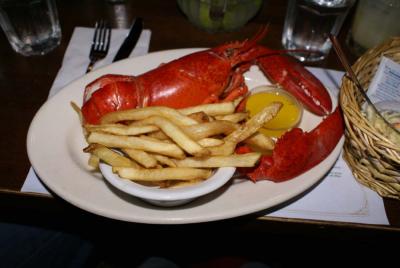
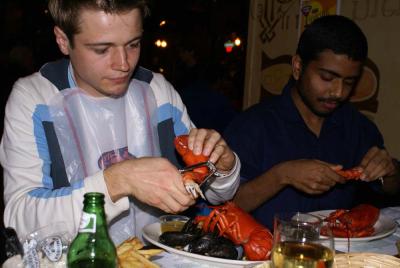
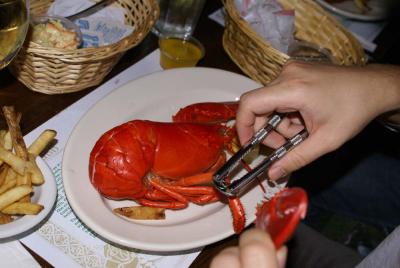
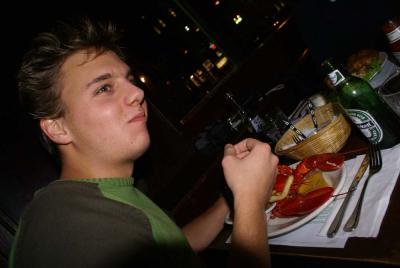
and finally we went to get our birthday present - real red bostonian lobsters. i was so excited when after the twists and turns we reached "the black rose", an old irish bar in downtown boston... but that was only before our lobster dinner arrived... to see this huge red animal in my plate was more scary then exciting and it was a while till i took the special tool to break the chela. the meat was good, however, and i immersed in my lobster and did not mind the french fries. until again i had to turn it upside down and see the belly and the legs... seyit helped me and my lobster with this... uhh... desperately i resorted to continue eating. actually it was more of a fight between me and the lobster and the guys really enjoyed laughing at me... killing frogs with blunt knives some years ago was almost like a joke:)
but the lobsters were over and we proceeded to the prudential tower. hung-yon, tathagat, michael, stephan, simon, seyit, uli and me. quan could not go with us that day...
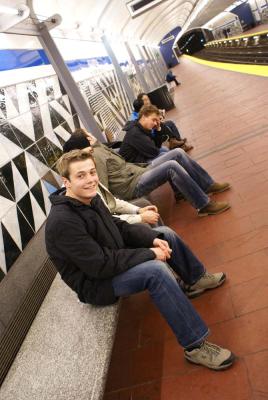
since in this fancy place they don't ask for liquor ID's (otherwise it would have caused me huge problems as i had left my passport at home), we enjoyed having the expensive cocktails on the 52nd floor, having the city of lights under our feet...
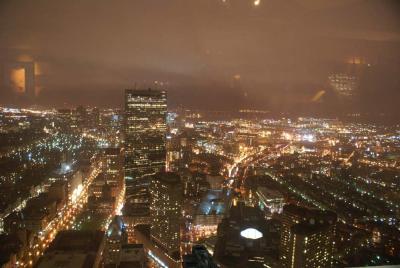
and then in started raining. no, pouring... cats and dogs... the wind and the strong strong rain in a rather warm night, running to catch our bus and running the wrong direction... going to cambridge "john harvard's" to warm up and take the next bus home... but the fun did not end there... it was still raining heavily, the streets were under water and i could not go home after the last shuttle missed me. wet wet wet.. waiting for half an hour in the rain... and the going back to watch silly shows on mtv... anyway, still this morning my durkheim and mauss' "primitive classification" which i took out of my bag at class was completely soaked:)
but the lobsters were over and we proceeded to the prudential tower. hung-yon, tathagat, michael, stephan, simon, seyit, uli and me. quan could not go with us that day...
since in this fancy place they don't ask for liquor ID's (otherwise it would have caused me huge problems as i had left my passport at home), we enjoyed having the expensive cocktails on the 52nd floor, having the city of lights under our feet...
and then in started raining. no, pouring... cats and dogs... the wind and the strong strong rain in a rather warm night, running to catch our bus and running the wrong direction... going to cambridge "john harvard's" to warm up and take the next bus home... but the fun did not end there... it was still raining heavily, the streets were under water and i could not go home after the last shuttle missed me. wet wet wet.. waiting for half an hour in the rain... and the going back to watch silly shows on mtv... anyway, still this morning my durkheim and mauss' "primitive classification" which i took out of my bag at class was completely soaked:)
jusionyte, 19:59h
... link (0 Kommentare) ... comment
Saturday, 11. November 2006
shopping
shopping friday. from cambridge and the harvard's bookstore to downtown boston for hats, gloves, shoes and jackets.
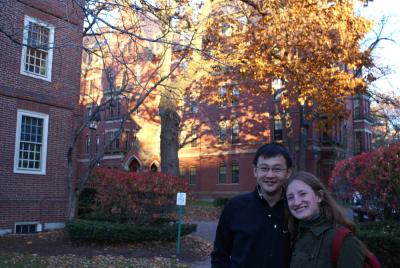
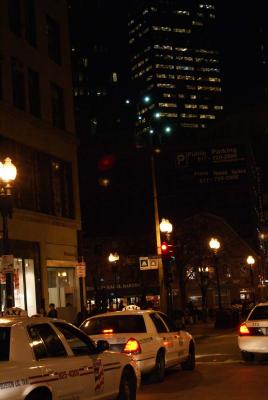
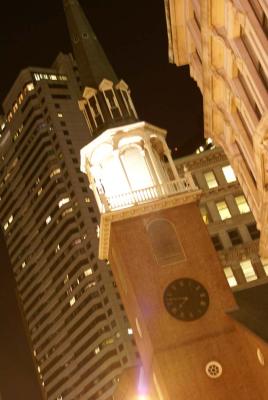
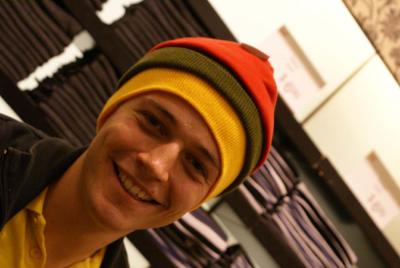
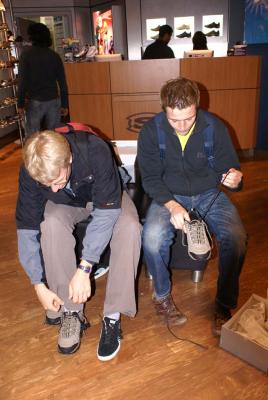
when the department of state gives me my fulbright money for the next month, i will go back... :) now bronchitis requires me to stay in bed as much as possible... with evans-pritchard and paul farmer.
when the department of state gives me my fulbright money for the next month, i will go back... :) now bronchitis requires me to stay in bed as much as possible... with evans-pritchard and paul farmer.
jusionyte, 19:24h
... link (2 Kommentare) ... comment
Sunday, 5. November 2006
"you have tendinitis"
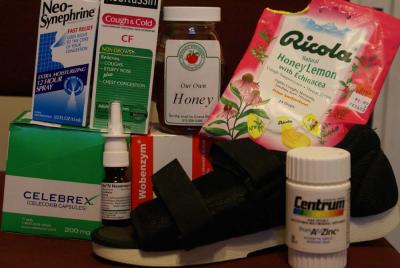
and so the story continues... rainy thursday morning i headed to the brandeis health center, but there i was told to go directly to the hospital. and so i did... again fifteen minutes in the rain with my aching foot. to hope street. what a coincidence to have a hospital on hope street... up the hill i went... and to the urgent care center i came... it was just before nine o'clock and it had just opened. unfortunately, my voice had deteriorated and i could not speak at all... just whisper loudly.... i was asked to sit down in the waiting room, had to fill in several forms about the current state of health and all the dozens of previous illnesses i had. of course, i marked as negative all the questions, i have never had any important disease, as far as i can remember... only wrote that "in my childhood i used to be allergic to some antibiotics, however, there is no evidence of which exactly". this statement made my lithuanian doctor laugh, but we'll reach that later... so... first i was taken to a male nurse. he checked my pulse, measured the temperature etc., then i was taken to the receptionist who registered me to the hospital, opened my file, copied my insurance card and marked that i complained about my right foot (by the way, the nurse made a mistake and first everyone thought that i have an injured left foot, not the right one). then yet another woman came and took me to have my foot x-rayed three times. and then i was seated in one room and was told to wait for the doctor. and the doctor came. his name was mark. his grandparents lived in vilnius but left lithuania under the tsarist rule and came here... what an encounter! he was so nice to me and then boasted to the whole personnel all around that "me and ieva could have been neighbors". funny doctor. good doctor. he told me i have tendinitis, which is an inflammation in the area of the tendon. usually joggers get this weird disease, but i haven't been jogging for a while... maybe i walk too much and the shoes are not that good... anyway, i was ordered to stay off feet as much as possible for at least three days, recieved a box of medicine and an interesting black shoe which prevents the foot of being bent. i thanked with the big efforts to raise my voice so that everybody could hear me... and i went home... in the rain... this hospital is one of the hundred best hospitals in the u.s., so i imagine what the cost will be for this treatment... but they did not ask me anything, i think they sent the bill directly to the insurance provider. and i sincerely hope that they cover it all. i suspect it to be several hundred dollars. if i hear nothing from them, maybe next week i go back to see my lithuanian doctor and ask about the other health problems i might have... coughing and the running nose... but my voice has returned:) and tonight arto will take me to the turkish-armenian dialogue meeting at harvard.
i still have the sheet my doctor gave me with all the directions about taking care of my foot... the last prescription was "see u in vilnius (voruta) at jogaila's house or king bathory's near the vilnia and neris rivers"...
jusionyte, 16:04h
... link (0 Kommentare) ... comment
Wednesday, 1. November 2006
halloween
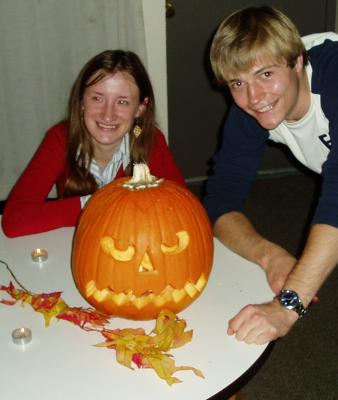
happy halloween-birthday ieva & uli! we made the pumpkins... the jack'o'lanterns... this was a collective marvel... uli cut the nose and the nice eyes and i made the smile:)
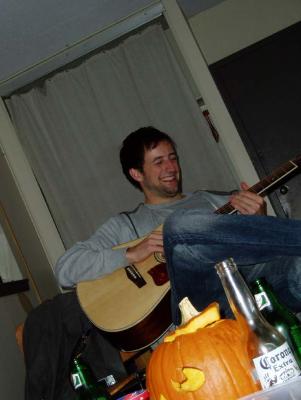
seyit and simon played the guitar and sang... pumpkin number two.
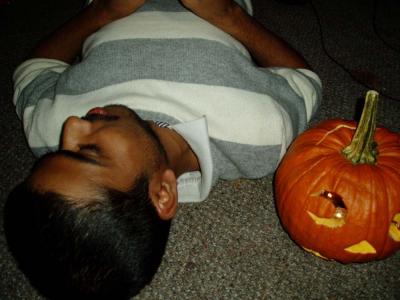
tathagat resting on the floor near another pumpkin...
all in all the birthday was just fantastic! we went to sleep today at four or maybe five in the morning and the room was completely messed up. we also got the coupons to go to eat lobster at the prudential tower in boston, which has a marvellous view over the city... today, unfortunately, i have lost my voice totally... and after a week of neglecting that my foot is ok, i noticed how swollen it really is and tomorrow will visit the hospital for the first time. i hope that doesn't cost all my money... we'll see how fulbright insurance works...
jusionyte, 21:47h
... link (0 Kommentare) ... comment
Saturday, 28. October 2006
waan ku yom ku dom ku baai
Being part of this exhibition project has been an amazing experience.
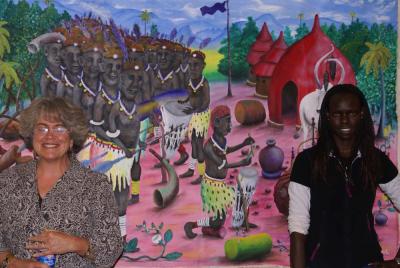
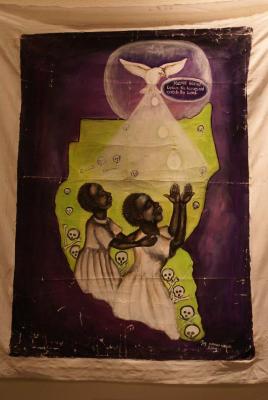
Firstly, the paintings themselves are beautiful, some really sad, some nostalgic, some showing the present day reality in Kakuma refugee camp and the lands of Dinka, Nuer and other people from Southern Sudan and the hopes of these people, but all colorful and reaching the depths of those who spend some time looking at them. Then, the entire process of arranging the paintings on the walls at Dreizer and discussions at class and after class that took hours were heated but worth engaging in. To stretch the canvases or leave them as they are? To write captions in an authoritative voice or let the artist and the community members speak about their impressions? Or maybe no captions are necessary and we could put all the information in a brochure? And what about the audio or video tour? Despite there being diverse opinions, we, as a class, succeeded in finding the solution which surprised me at the opening ceremony. It was a great event.
As an anthropologist I am eager to study immigrant communities in the U.S. and the plurality of memories in the public space, and being involved in this project I had a chance to listen to stories of the refugees, survivors of the genocide which the world did not notice at the time. Although I did spent some afternoons creating texts for the captions and then printing and sticking them to the foam board, which is an unavoidable job one has to engage in when making an exhibition, it was really the possibility to meet the members of the Southern Sudanese diaspora community that was the most rewarding for me as a person, as an academic and as a journalist. Talking to Atem Aleu over the phone about the danger of going back to his memories and the empty village, listening to Panther Alier sharing his memories of daily life and survival in the refugee camps, walking through the paintings in the gallery with another Atem, taking pictures of the performances of Southern Sudanese and the auction in Lincoln where the naming rights and the reproductions of the paintings were sold to good-willing citizens of the U.S. – these were the moments that I treasure the most. I believe that without the cooperation with the refugee community and the Sudanese Education Fund, especially Susan Winship, we could not have gone so far. And, undoubtedly, the class benefited a lot from having Aduei among us all the time – her opinion was crucially important and she explained many things of which we had not been aware.
What would be the important moments that I remember?
Certainly, we were struggling between creating an exhibition based on resonance and that of wonder, as S. Greenblatt would say. On the one hand, we wanted to tell the story, to make people aware of what was and is happening in Southern Sudan, to explain what symbols and what narratives are depicted in the paintings; that is, as students of anthropology, cultural production or other social sciences we wanted to educate. Aduei was particularly firm on this position. But on the other hand, exhibiting paintings is not the same as putting some household items on display. Although these are the objects of legacy telling the story of Southern Sudan, they are also works of art, they are the visions by individual painters, most still in the camp and not all of them Dinka. I recall that understanding the paintings of Stephenal was difficult even for the Southern Sudanese and they came up with different interpretations when viewing them. Usually, art galleries do not attach captions to their paintings, telling what and why is being depicted in each of them. What change would it make if under E. Munch’s “The Cry” one could read “the author makes reference to the fate of an individual in our society, etc.”? We were trapped and I did not really know how to balance the need of resonance and the wish to leave some space to wonder until the idea of using the quotes from the interviews that we had recorded came up. Let the artist speak for himself, let other community members, who have similar backgrounds, talk about them, and let the class also add its comments where appropriate. The decision to use multiple voices was a perfect solution to the problem and I have heard many compliments to the class for doing this.
The exhibition is our collective project and probably it is this dynamism and fusion of ideas that come from our different backgrounds that make it so dear to me. I am more than certain that we should not break it up, that we should not take the paintings to some dark room at Brandeis for years of loneliness in the dust. We should make it travel and make sure that as many people as possible see it. It might be our small contribution to assisting the people of Southern Sudan. The days of Victorian anthropologists who would work side by side with the government and the colonial powers to subject local peoples are long gone. The anthropologists have moved underground, they have joined their communities to work hand in hand in their struggle against the social and political injustice. This is what is meant by engaged anthropology and that is the kind of social science that I find meaningful.
Visit our class wiki, until we create the official website:
http://museumsmemory.wikispaces.com/South+Sudan+Community+Project
Firstly, the paintings themselves are beautiful, some really sad, some nostalgic, some showing the present day reality in Kakuma refugee camp and the lands of Dinka, Nuer and other people from Southern Sudan and the hopes of these people, but all colorful and reaching the depths of those who spend some time looking at them. Then, the entire process of arranging the paintings on the walls at Dreizer and discussions at class and after class that took hours were heated but worth engaging in. To stretch the canvases or leave them as they are? To write captions in an authoritative voice or let the artist and the community members speak about their impressions? Or maybe no captions are necessary and we could put all the information in a brochure? And what about the audio or video tour? Despite there being diverse opinions, we, as a class, succeeded in finding the solution which surprised me at the opening ceremony. It was a great event.
As an anthropologist I am eager to study immigrant communities in the U.S. and the plurality of memories in the public space, and being involved in this project I had a chance to listen to stories of the refugees, survivors of the genocide which the world did not notice at the time. Although I did spent some afternoons creating texts for the captions and then printing and sticking them to the foam board, which is an unavoidable job one has to engage in when making an exhibition, it was really the possibility to meet the members of the Southern Sudanese diaspora community that was the most rewarding for me as a person, as an academic and as a journalist. Talking to Atem Aleu over the phone about the danger of going back to his memories and the empty village, listening to Panther Alier sharing his memories of daily life and survival in the refugee camps, walking through the paintings in the gallery with another Atem, taking pictures of the performances of Southern Sudanese and the auction in Lincoln where the naming rights and the reproductions of the paintings were sold to good-willing citizens of the U.S. – these were the moments that I treasure the most. I believe that without the cooperation with the refugee community and the Sudanese Education Fund, especially Susan Winship, we could not have gone so far. And, undoubtedly, the class benefited a lot from having Aduei among us all the time – her opinion was crucially important and she explained many things of which we had not been aware.
What would be the important moments that I remember?
Certainly, we were struggling between creating an exhibition based on resonance and that of wonder, as S. Greenblatt would say. On the one hand, we wanted to tell the story, to make people aware of what was and is happening in Southern Sudan, to explain what symbols and what narratives are depicted in the paintings; that is, as students of anthropology, cultural production or other social sciences we wanted to educate. Aduei was particularly firm on this position. But on the other hand, exhibiting paintings is not the same as putting some household items on display. Although these are the objects of legacy telling the story of Southern Sudan, they are also works of art, they are the visions by individual painters, most still in the camp and not all of them Dinka. I recall that understanding the paintings of Stephenal was difficult even for the Southern Sudanese and they came up with different interpretations when viewing them. Usually, art galleries do not attach captions to their paintings, telling what and why is being depicted in each of them. What change would it make if under E. Munch’s “The Cry” one could read “the author makes reference to the fate of an individual in our society, etc.”? We were trapped and I did not really know how to balance the need of resonance and the wish to leave some space to wonder until the idea of using the quotes from the interviews that we had recorded came up. Let the artist speak for himself, let other community members, who have similar backgrounds, talk about them, and let the class also add its comments where appropriate. The decision to use multiple voices was a perfect solution to the problem and I have heard many compliments to the class for doing this.
The exhibition is our collective project and probably it is this dynamism and fusion of ideas that come from our different backgrounds that make it so dear to me. I am more than certain that we should not break it up, that we should not take the paintings to some dark room at Brandeis for years of loneliness in the dust. We should make it travel and make sure that as many people as possible see it. It might be our small contribution to assisting the people of Southern Sudan. The days of Victorian anthropologists who would work side by side with the government and the colonial powers to subject local peoples are long gone. The anthropologists have moved underground, they have joined their communities to work hand in hand in their struggle against the social and political injustice. This is what is meant by engaged anthropology and that is the kind of social science that I find meaningful.
Visit our class wiki, until we create the official website:
http://museumsmemory.wikispaces.com/South+Sudan+Community+Project
jusionyte, 17:10h
... link (0 Kommentare) ... comment
... older stories