... newer stories
Saturday, 28. October 2006
waan ku yom ku dom ku baai
Being part of this exhibition project has been an amazing experience.
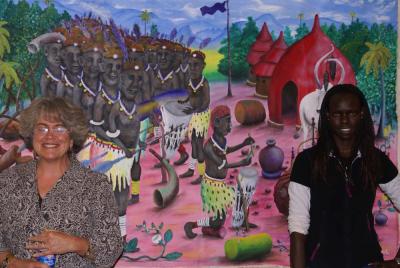
Firstly, the paintings themselves are beautiful, some really sad, some nostalgic, some showing the present day reality in Kakuma refugee camp and the lands of Dinka, Nuer and other people from Southern Sudan and the hopes of these people, but all colorful and reaching the depths of those who spend some time looking at them. Then, the entire process of arranging the paintings on the walls at Dreizer and discussions at class and after class that took hours were heated but worth engaging in. To stretch the canvases or leave them as they are? To write captions in an authoritative voice or let the artist and the community members speak about their impressions? Or maybe no captions are necessary and we could put all the information in a brochure? And what about the audio or video tour? Despite there being diverse opinions, we, as a class, succeeded in finding the solution which surprised me at the opening ceremony. It was a great event.
As an anthropologist I am eager to study immigrant communities in the U.S. and the plurality of memories in the public space, and being involved in this project I had a chance to listen to stories of the refugees, survivors of the genocide which the world did not notice at the time. Although I did spent some afternoons creating texts for the captions and then printing and sticking them to the foam board, which is an unavoidable job one has to engage in when making an exhibition, it was really the possibility to meet the members of the Southern Sudanese diaspora community that was the most rewarding for me as a person, as an academic and as a journalist. Talking to Atem Aleu over the phone about the danger of going back to his memories and the empty village, listening to Panther Alier sharing his memories of daily life and survival in the refugee camps, walking through the paintings in the gallery with another Atem, taking pictures of the performances of Southern Sudanese and the auction in Lincoln where the naming rights and the reproductions of the paintings were sold to good-willing citizens of the U.S. – these were the moments that I treasure the most. I believe that without the cooperation with the refugee community and the Sudanese Education Fund, especially Susan Winship, we could not have gone so far. And, undoubtedly, the class benefited a lot from having Aduei among us all the time – her opinion was crucially important and she explained many things of which we had not been aware.
What would be the important moments that I remember?
Certainly, we were struggling between creating an exhibition based on resonance and that of wonder, as S. Greenblatt would say. On the one hand, we wanted to tell the story, to make people aware of what was and is happening in Southern Sudan, to explain what symbols and what narratives are depicted in the paintings; that is, as students of anthropology, cultural production or other social sciences we wanted to educate. Aduei was particularly firm on this position. But on the other hand, exhibiting paintings is not the same as putting some household items on display. Although these are the objects of legacy telling the story of Southern Sudan, they are also works of art, they are the visions by individual painters, most still in the camp and not all of them Dinka. I recall that understanding the paintings of Stephenal was difficult even for the Southern Sudanese and they came up with different interpretations when viewing them. Usually, art galleries do not attach captions to their paintings, telling what and why is being depicted in each of them. What change would it make if under E. Munch’s “The Cry” one could read “the author makes reference to the fate of an individual in our society, etc.”? We were trapped and I did not really know how to balance the need of resonance and the wish to leave some space to wonder until the idea of using the quotes from the interviews that we had recorded came up. Let the artist speak for himself, let other community members, who have similar backgrounds, talk about them, and let the class also add its comments where appropriate. The decision to use multiple voices was a perfect solution to the problem and I have heard many compliments to the class for doing this.
The exhibition is our collective project and probably it is this dynamism and fusion of ideas that come from our different backgrounds that make it so dear to me. I am more than certain that we should not break it up, that we should not take the paintings to some dark room at Brandeis for years of loneliness in the dust. We should make it travel and make sure that as many people as possible see it. It might be our small contribution to assisting the people of Southern Sudan. The days of Victorian anthropologists who would work side by side with the government and the colonial powers to subject local peoples are long gone. The anthropologists have moved underground, they have joined their communities to work hand in hand in their struggle against the social and political injustice. This is what is meant by engaged anthropology and that is the kind of social science that I find meaningful.
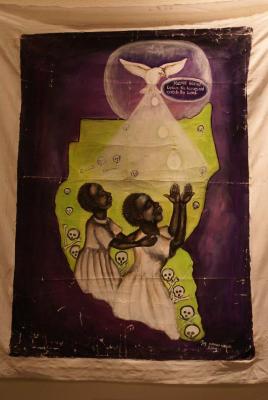
Visit our class wiki, until we create the official website:
http://museumsmemory.wikispaces.com/South+Sudan+Community+Project
Firstly, the paintings themselves are beautiful, some really sad, some nostalgic, some showing the present day reality in Kakuma refugee camp and the lands of Dinka, Nuer and other people from Southern Sudan and the hopes of these people, but all colorful and reaching the depths of those who spend some time looking at them. Then, the entire process of arranging the paintings on the walls at Dreizer and discussions at class and after class that took hours were heated but worth engaging in. To stretch the canvases or leave them as they are? To write captions in an authoritative voice or let the artist and the community members speak about their impressions? Or maybe no captions are necessary and we could put all the information in a brochure? And what about the audio or video tour? Despite there being diverse opinions, we, as a class, succeeded in finding the solution which surprised me at the opening ceremony. It was a great event.
As an anthropologist I am eager to study immigrant communities in the U.S. and the plurality of memories in the public space, and being involved in this project I had a chance to listen to stories of the refugees, survivors of the genocide which the world did not notice at the time. Although I did spent some afternoons creating texts for the captions and then printing and sticking them to the foam board, which is an unavoidable job one has to engage in when making an exhibition, it was really the possibility to meet the members of the Southern Sudanese diaspora community that was the most rewarding for me as a person, as an academic and as a journalist. Talking to Atem Aleu over the phone about the danger of going back to his memories and the empty village, listening to Panther Alier sharing his memories of daily life and survival in the refugee camps, walking through the paintings in the gallery with another Atem, taking pictures of the performances of Southern Sudanese and the auction in Lincoln where the naming rights and the reproductions of the paintings were sold to good-willing citizens of the U.S. – these were the moments that I treasure the most. I believe that without the cooperation with the refugee community and the Sudanese Education Fund, especially Susan Winship, we could not have gone so far. And, undoubtedly, the class benefited a lot from having Aduei among us all the time – her opinion was crucially important and she explained many things of which we had not been aware.
What would be the important moments that I remember?
Certainly, we were struggling between creating an exhibition based on resonance and that of wonder, as S. Greenblatt would say. On the one hand, we wanted to tell the story, to make people aware of what was and is happening in Southern Sudan, to explain what symbols and what narratives are depicted in the paintings; that is, as students of anthropology, cultural production or other social sciences we wanted to educate. Aduei was particularly firm on this position. But on the other hand, exhibiting paintings is not the same as putting some household items on display. Although these are the objects of legacy telling the story of Southern Sudan, they are also works of art, they are the visions by individual painters, most still in the camp and not all of them Dinka. I recall that understanding the paintings of Stephenal was difficult even for the Southern Sudanese and they came up with different interpretations when viewing them. Usually, art galleries do not attach captions to their paintings, telling what and why is being depicted in each of them. What change would it make if under E. Munch’s “The Cry” one could read “the author makes reference to the fate of an individual in our society, etc.”? We were trapped and I did not really know how to balance the need of resonance and the wish to leave some space to wonder until the idea of using the quotes from the interviews that we had recorded came up. Let the artist speak for himself, let other community members, who have similar backgrounds, talk about them, and let the class also add its comments where appropriate. The decision to use multiple voices was a perfect solution to the problem and I have heard many compliments to the class for doing this.
The exhibition is our collective project and probably it is this dynamism and fusion of ideas that come from our different backgrounds that make it so dear to me. I am more than certain that we should not break it up, that we should not take the paintings to some dark room at Brandeis for years of loneliness in the dust. We should make it travel and make sure that as many people as possible see it. It might be our small contribution to assisting the people of Southern Sudan. The days of Victorian anthropologists who would work side by side with the government and the colonial powers to subject local peoples are long gone. The anthropologists have moved underground, they have joined their communities to work hand in hand in their struggle against the social and political injustice. This is what is meant by engaged anthropology and that is the kind of social science that I find meaningful.
Visit our class wiki, until we create the official website:
http://museumsmemory.wikispaces.com/South+Sudan+Community+Project
jusionyte, 17:10h
... link (0 Kommentare) ... comment
... older stories